
 Positive Behavioral Interventions
and Supports
1. “What is PBIS?”
Improving student academic and behavior outcomes is about ensuring all students have access to the most effective and accurately implemented instructional and behavioral practices and interventions possible. PBIS provides an operational framework for achieving these outcomes. More importantly, PBIS is NOT a curriculum, intervention, or practice, but IS a decision making framework that guides selection, integration, and implementation of the best evidence-based academic and behavioral practices for improving important academic and behavior outcomes for all students.
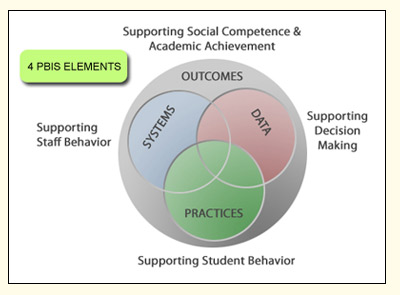 2. “What Does PBIS Emphasize?”
In general, PBIS emphasizes four integrated elements: (a) data for decision making, (b) measurable outcomes supported and evaluated by data, (c) practices with evidence that these outcomes are achievable, and (d) systems that efficiently and effectively support implementation of these practices.
Early Childhood Teaching Pyramid for A Tiered Model of Prevention and Intervention
1. Primary Level
The first and, arguably, the most fundamental category concerns the quality of positive relationships developed between the child and the child’s parents, teachers, child care professionals, other caring adults and, eventually, peers. It is well understood that a child’s healthy social-emotional development is a function of the stability, security, and consistency of trusting, affectionate relationships that are developed during the child’s years as an infant and toddler. These relationships provide the context and the mold from which the child’s future relationships and interactions will emerge, and they serve as the basis for the early guidance and instruction that adults offer for the child. The stronger the positive relationship an adult has with a child, the more effective the adult will be in helping the child acquire social competencies.
Also warranting consideration as primary prevention practices are basic levels of adult-child interactions, guidance and modeling with respect to empathy for others, assistance with problem solving, and the provision of comprehensible, predictable and stimulating environments. These practices are manifested as fundamental guidelines for positive parenting, and the physical arrangements associated with safety and orderliness in home, child care, and classroom settings. It is understood that adherence to such guidelines for all children will help promote healthy social-emotional development and reduce the incidence of serious challenging behavior.
2. Secondary Level
Secondary prevention practices are geared for children who experience circumstances known to increase the risk of social-emotional disorders and the development of challenging behaviors. Such risk factors may include poverty, exposure to abusive, neglectful or violent home situations, delays or disabilities in learning or communication, maternal depression and other variables. A variety of parent training, social skills and social-emotional curricula, and multi-component intervention programs have been developed to provide assistance for these children.
3. Tertiary Level
The top level of the teaching pyramid refers to those relatively few young children who already demonstrate patterns of persistent challenging behavior and who require more concerted and individualized intervention efforts. The challenging behaviors of these children may accompany a developmental delay or disability (due to increased risk factors), though a diagnosis or identified disability is not necessarily present.